Aluminum Foil for Semi-rigid Aluminum Flexible Ducts
The spiral bonding molding process of semi-rigid aluminum flexible ducts places extremely stringent comprehensive performance requirements on the base aluminum foil—it must maintain structural integrity during continuous bending, provide sufficient tear resistance at the seams, and simultaneously ensure airtightness and corrosion resistance for long-term use. As the core load-bearing material of the duct system, the alloy selection, condition control, and surface quality of the aluminum foil directly determine the mechanical properties, service life, and system energy efficiency of the finished duct.
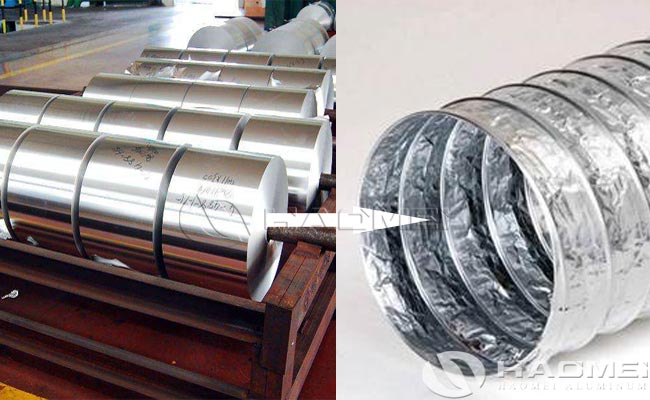
Alloy System: Why 8011 is the Preferred Base Material for Semi-rigid Ducts?
During the spiral molding process of semi-rigid ducts, the aluminum foil undergoes repeated bending and bonding deformation. Pure aluminum (1xxx series) lacks sufficient strength and is prone to deformation, while 3003 alloy, with its excessive hardness, is prone to cracking at the seams. 8011 alloy, with Al≥98.5% as the matrix and the addition of 0.6–1.0% Fe and 0.5–0.9% Si to form a dispersed strengthening phase, achieves a tensile strength (H24 state) of 140–180 MPa and maintains an elongation of 12–16%. The balance between strength and plasticity perfectly matches the forming stress curve of spiral ducts. Compared to 1100 pure aluminum foil, 8011 aluminum foil offers approximately 35% improved tear resistance and 28% better peel resistance at the seams, making it the most cost-effective alloy choice in the industry.
Matching by Hardening State: Different Hardening States Correspond to Different Duct Application Scenarios
The delivery state of the aluminum foil directly affects the forming difficulty and finished rigidity of the duct. O-state (fully annealed) aluminum foil has an elongation of ≥20%, suitable for producing flexible ducts with large diameters and large helix pitches. It has low forming resistance and good edge sealing, but the radial stiffness of the finished product is relatively low. H24 temper balances strength and formability, with a tensile strength of 140–180 MPa, making it the mainstream choice for semi-rigid ducts in medium-pressure ventilation systems. After forming, the duct maintains a circular cross-section without collapse and withstands a static pressure of 1500 Pa with a deformation of ≤3%. H26 temper has even higher strength (180–220 MPa), suitable for high-pressure systems or small-diameter ducts with higher rigidity requirements, but it requires higher precision in the rolling of the forming equipment and necessitates the use of a dedicated locking die.
Pinhole control and surface quality: Key indicators determining system airtightness.
The air leakage rate of a ventilation system is a core indicator for measuring project quality, and the pinhole density of the aluminum foil directly affects the airtightness of the finished duct. High-quality aluminum foil for air duct employs a quadruple cold rolling + continuous annealing process, controlling the pinhole rate to below 0.3 pinholes/m², with zero pinholes larger than 0.1mm. Combined with a triple-sealing structure featuring spiral seams, the finished ductwork leakage rate can be controlled to within 0.5%, far below the ≤2% leakage rate requirement for low-pressure systems in GB 50243 standard. Simultaneously, the aluminum foil surface tension must be stable at 32–36 dyn/cm to ensure strong adhesion when laminated with insulation materials such as glass wool and phenolic resin, with a peel strength ≥1.8N/cm, preventing delamination and bubbling over long-term use.
Long-term reliability: The engineering value of weather resistance and corrosion resistance.
Semi-rigid flexible aluminium duct is commonly used in damp or mildly corrosive environments such as basements, kitchen and bathroom exhaust systems, and industrial plants. Surface passivation treatment of the aluminum foil is crucial. The dense oxide film formed through an online chemical passivation process allows the aluminum foil to withstand 1200 hours of neutral salt spray testing without significant corrosion, extending its service life by 2–3 times compared to ordinary aluminum foil. Under temperature cycling conditions ranging from -40℃ to 120℃, the mechanical properties of 8011 aluminum foil retain ≥95%, without embrittlement or strength degradation due to alternating hot and cold temperatures, ensuring stable operation throughout the entire lifecycle of the ventilation system.
In summary, the performance of semi-rigid aluminum flexible ducts is essentially an external manifestation of the comprehensive performance of the aluminum foil material. From alloy composition to hardening state, from pinhole control to surface treatment, precise control of every material parameter ultimately translates into the reliability and energy efficiency advantages of the duct system.
This resource is from: https://www.aluminum-foil.net/aluminum-foil-for-semi-rigid-aluminum-flexible-ducts/
Should you be interested in, please contact us at:
Haomei Aluminum
Whatsapp/Wechat: 0086 181 3788 9531
Email: nydia@aluminumhm.com


评论
发表评论